Single Magnet Mixer

Laboratory automation

Single Magnet Mixer

Chromtech

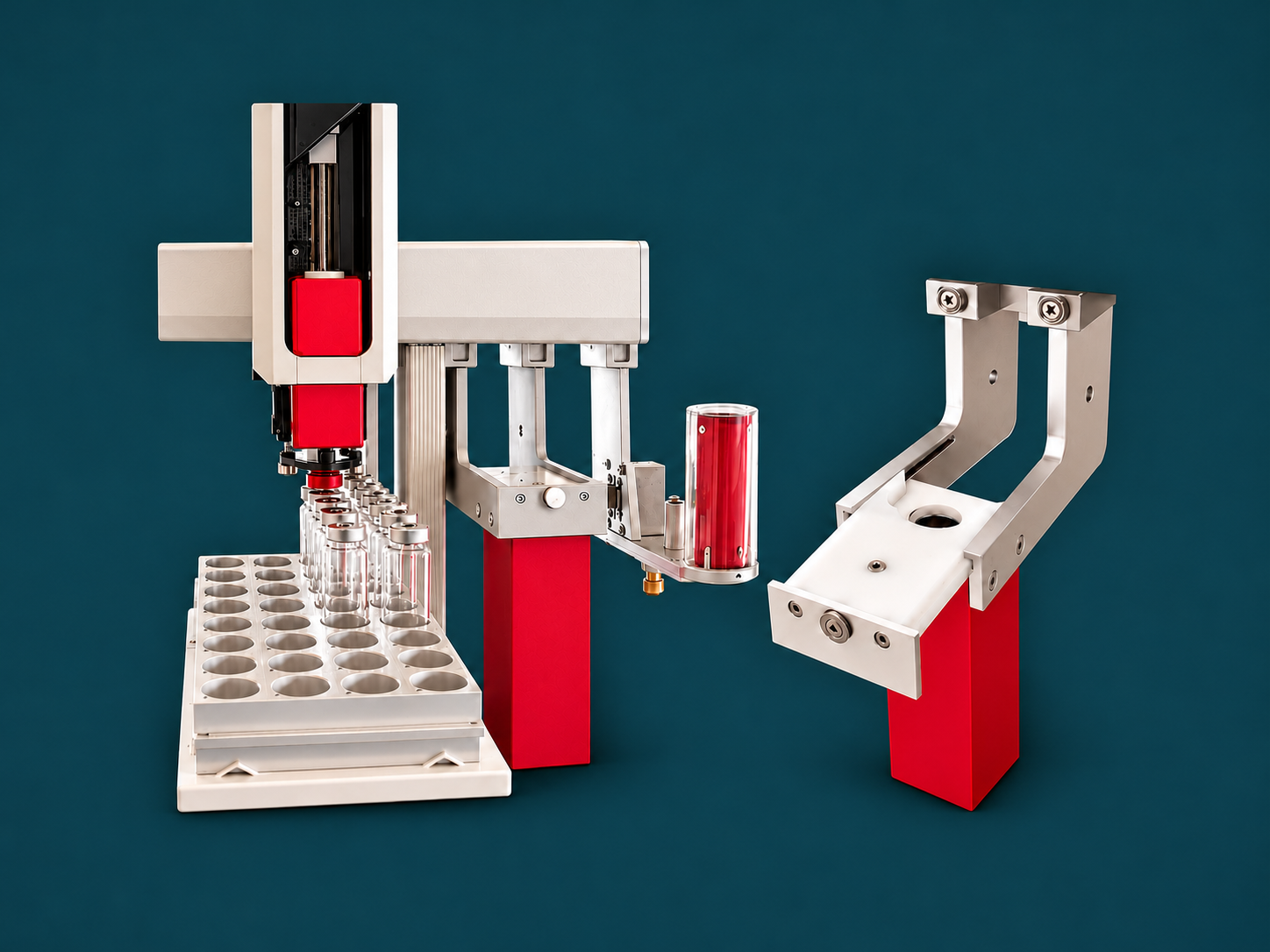
The single magnet mixer (SMM) from Chromtech automatically stirs and tempers samples. It is available for PAL3 RTC and RSI from CTC Analytics as well as for the older PAL-classic generation.

Manufacturer
Chromtech
Product range
Laboratory automation
Advice
Direct from Chromtech

Stirring and tempering

Mix intensively, gently extract.

The Single Magnet Mixer (SMM) stirs the sample with a small magnetic stir bar in the vial. A stepper motor drives the stirring process; heating and stirring are controlled by PAL3 and any PAL control software. Speed and direction of rotation can be selected, including alternating directions.

  • For SPME, SPME Arrow, SPDE and Headspace Analytics
  • Gently immersed SPME fibers, since the sample vessel does not have to be moved during stirring
  • Also for mixing and heating in automated sample preparation, for example for derivatization
  • Heating up to 150 °C; optionally with Peltier cooling up to about 5 °C
  • For 20 ml sample vessels; inserts available for 2 and 10 ml

SPME means solid phase microextraction; SPME Arrow uses a larger extraction element. SPDE refers to dynamic solid phase extraction. Headspace is the analysis of the gas space over a sample. The attainable temperature depends on the design and operating conditions.

Single Magnet Mixer (SMM) – Product brochure · English · 1 page ↗

Additional Chromtechoption

Mix samples, condition fibers.

While the SMM stirs and controls the sample temperature, SP400 conditions the SPME fiber after extraction and desorption. SP400 complements the automated workflow as a Chromtech PAL3 option and is also available for older PAL systems.

SP400 – condition SPME fibers →

Application Notes

SPME with the single magnet mixer in practice.

Application Note 1 · English · 3 pages

Reproducibility with repeated SPME extraction

BTEX in water was repeatedly extracted via a PDMS fiber using the Single Magnet Mixer. After taking into account the expected sample removal, the relative standard deviations of the investigated components were between 0.75 and 1.12 percent.

0,75–1,12 % relative standard deviationOpen English PDF
Application Note 2 · English · 3 pages

Single Magnet Mixer Compared to Agitator

A beer sample mixed with BTEX was examined by SPME with SMM and agitator. For several higher-boiling components, the SMM showed better reproducibility and on average around 15 percent more signal.

Around 15% more signal on averageOpen English PDF

Terms: SPME refers to solid phase microextraction. BTEX represents benzene, toluene, ethylbenzene and xylenes. The relative standard deviation describes the variance of repeated measurements in relation to the mean value.

Advice and integration

For the appropriate system configuration.

Whether this product fits your application depends on the sample, method and existing device environment. We clarify the requirements, coordinate the configuration and accompany the integration into your laboratory process.

Appropriate applications