
Product information · EnglishAquaTrace ASPE900: automated solid phase extraction for water samples
Open PDF →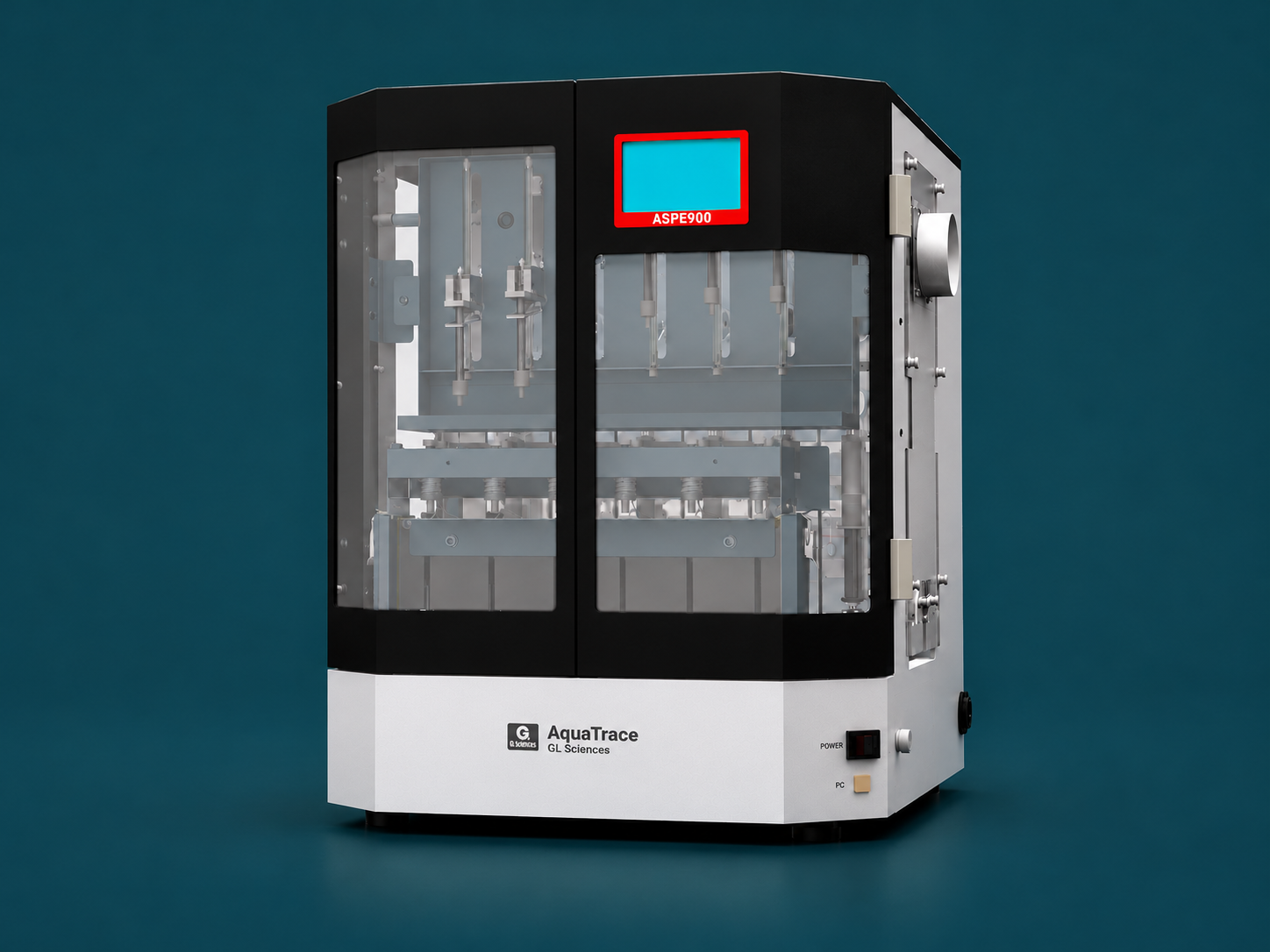
Laboratory automation
AquaTrace ASPE900
GL Sciences
AquaTrace ASPE900 from GL Sciences automates solid-phase extraction of water samples on up to six parallel lines. Conditioning, loading, rinsing, drying, elution and evaporation are combined in one system.
- Manufacturer
- GL Sciences
- Product range
- Laboratory automation
- Advice
- Direct from Chromtech
GL Sciences · Sample preparation
From the water sample to the concentrated extract.
This stand-alone system prepares tap water, drinking water and groundwater for subsequent chromatographic analysis. Automated processing reduces repetitive manual extraction work. A valveless piston pump delivers samples and solvents while flow paths are switched under method control.
- Process up to six samples in parallel
- Automate the extraction workflow including evaporation
- Set up methods and monitor progress on the colour touchscreen
- Store up to 120 methods on the instrument and 120 on USB memory
- Use up to seven solvent positions for flexible workflows
- Use Luer-connected cartridges; 6 mL syringe-barrel format as standard
Automated workflow
Six steps in one system.
- Conditioning
Prepare the selected cartridge with the solvents specified by the method.
- Sample loading
Pass water through the sorbent at a controlled flow to retain target compounds.
- Rinsing
Remove interfering matrix components with a suitable rinse step.
- Drying
Remove residual water by suction, nitrogen purging or a combination of both.
- Elution
Transfer retained compounds into collection tubes using the selected solvent.
- Evaporation
Concentrate the eluate inside the instrument with nitrogen and optional heating in an aluminium block at 30 to 60 °C.
Operation and documentation
From loading to the finished extract.
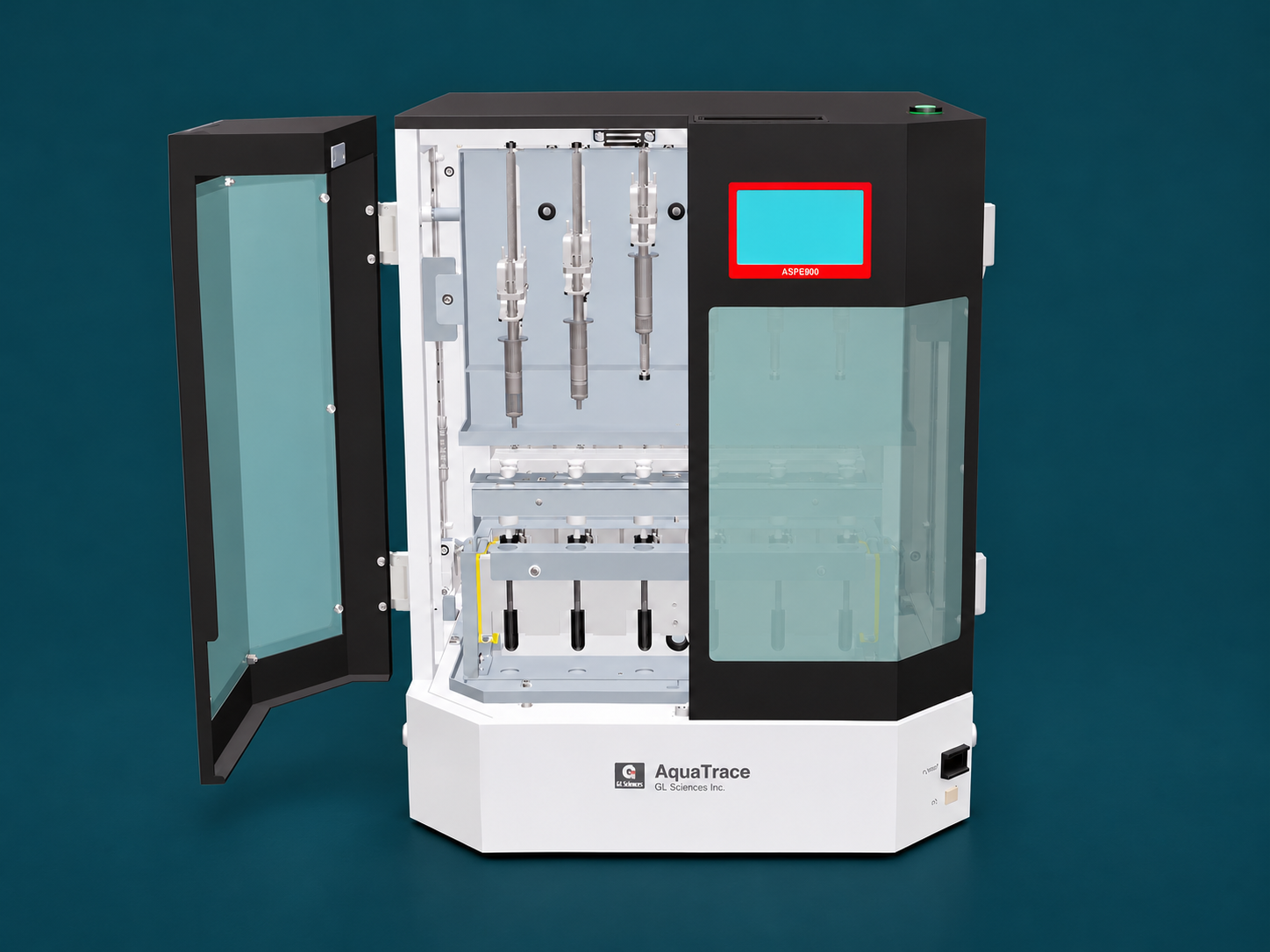
After loading samples, cartridges and solvents, select a stored method. Individual lines can be selected and a timer defines the start and end of operation. The screen shows process progress and remaining time. Edited parameters can be saved and the calculated total duration is updated.
The ASSISTANT PC application supports method editing, transfer and documentation. Reports combine an automatically generated flow diagram with settings and user notes such as cartridge type, batch or sampling location. Logs record operation and maintenance; reports can be printed or saved as PDF. The email function requires a PC with an internet connection.
Concentrate and clean
Graduated GL-SPE tubes allow concentration directly in the system. Nitrogen is directed at an angle onto the tube wall. An optional liquid-level sensor stops nitrogen delivery at a selected final volume between 0.1 and 5 mL. The usable range depends on the equipment and method.
Sample lines can be rinsed with organic solvents, including toluene. Suitable rinsing steps help reduce carryover between samples. Cartridge, solvent, sample matrix and target compounds must be selected together for the method.
Technical data
- Sample lines
- Up to 6 in parallel
- Delivery principle
- Valveless piston pump
- Operation
- Colour LCD touchscreen
- Solvent positions
- Up to 7
- Method storage
- 120 on instrument / 120 on USB
- Cartridge connection
- Luer; 6 mL syringe-barrel format as standard
- Sample volume setting
- 10 to 99,990 mL
- Sample flow rate
- 0.5 to 80 mL/min
- Elution and soak flow
- 1.0 to 80.0 mL/min
- Dehydration
- Suction, nitrogen or combined
- Concentration
- Nitrogen; with or without heating block
- Heating block
- 30 to 60 °C
- Concentration tubes
- GL-SPE 6 / 7 mL; 10 mL optional
- Other collection tubes
- Up to 16 mL, without concentration
- Liquid-level sensor
- Optional; final volume 0.1 to 5 mL
- External signals
- Ready input; stop, end and error outputs
- Dimensions (W × D × H)
- 480 × 560 × 615 mm
- Weight, standard
- Approx. 50 kg
- Power requirements
- 220 V AC ±10 %, 50/60 Hz, 240 VA
Dimensions exclude protrusions and include rubber feet. The volume range is a setting range, not a cartridge capacity claim. The manufacturer specifies volume accuracy of less than ±2% under test conditions: ultrapure water, 20 mL/min aspiration/delivery rate, no load. Flow, recovery and final volume depend on the method.
Terms: SPE means solid-phase extraction: a sorbent retains target compounds, which are then eluted with a solvent. LCD means liquid crystal display. LC/MS and GC/MS combine liquid or gas chromatography with mass spectrometry.
Advice and integration
For the appropriate system configuration.
Whether this product fits your application depends on the sample, method and existing device environment. We clarify the requirements, coordinate the configuration and accompany the integration into your laboratory process.
Appropriate applications
Documents