
Product information · EnglishAgilent 5987A – Data sheet
Open PDF →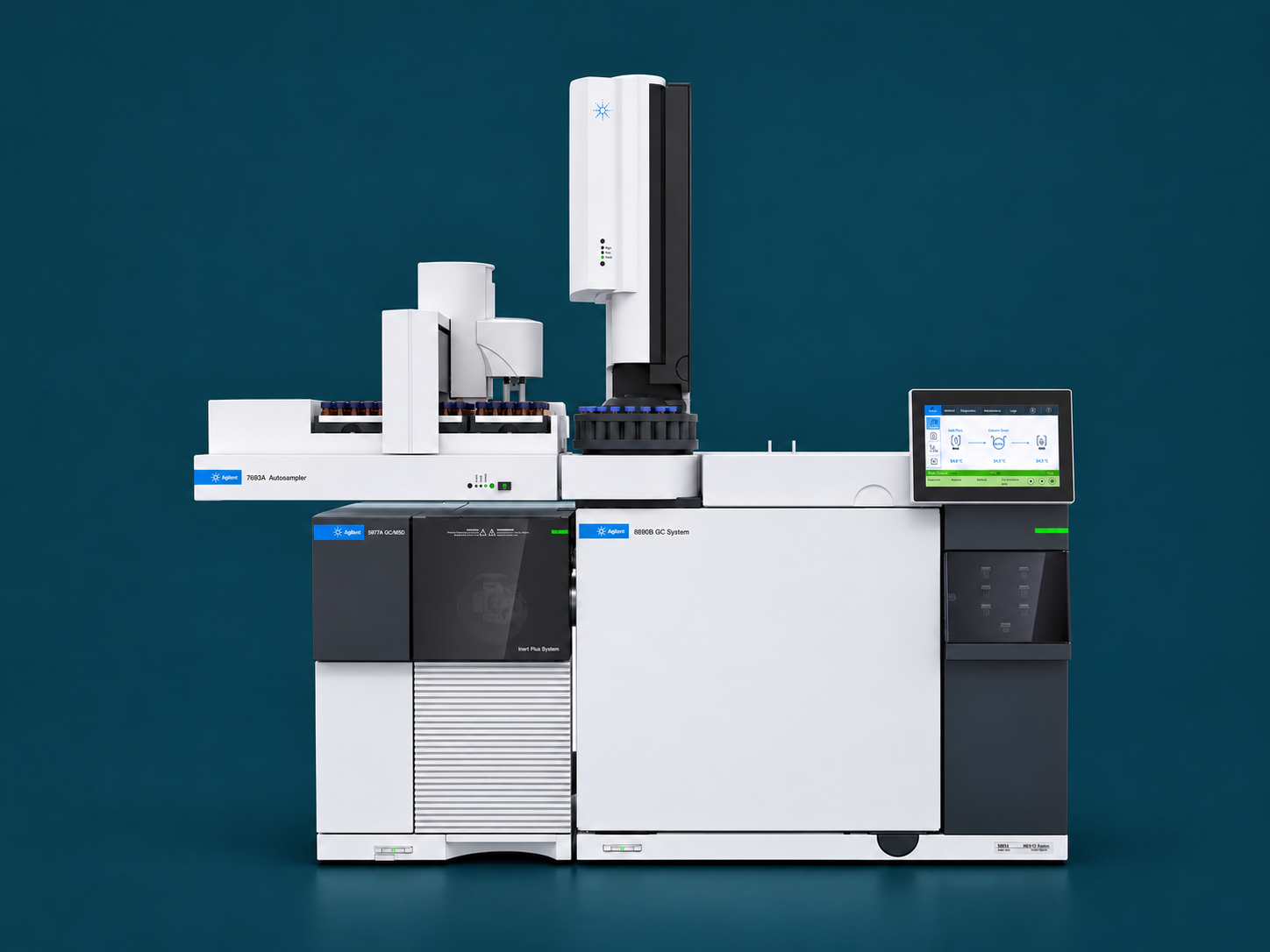
GC/MS
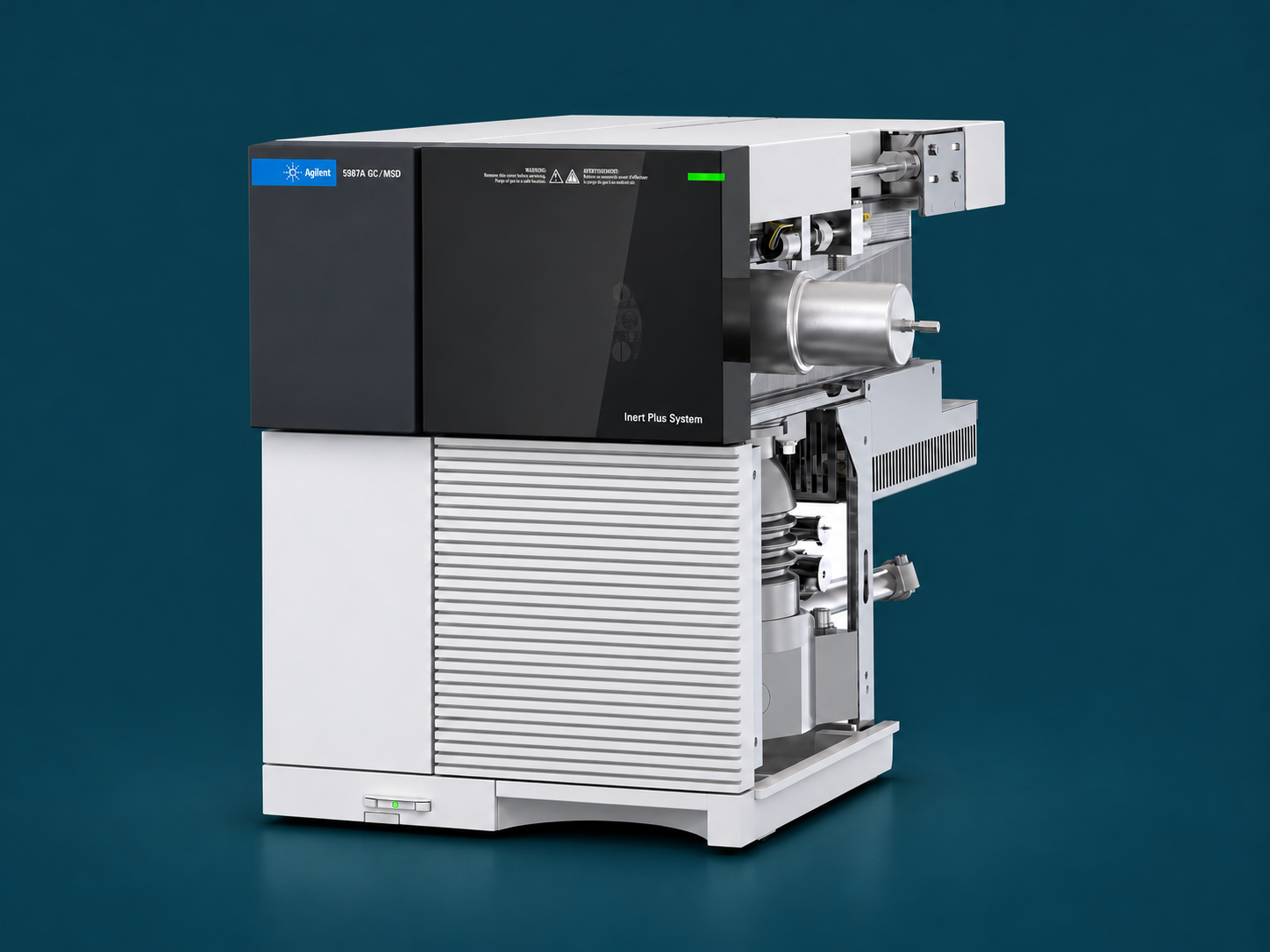
Agilent 5987A GC/MSD
Agilent Technologies
The Agilent 5987A GC/MSD succeeds the 5977C. A new ER detector, faster scanning and dynamic ion monitoring extend routine and trace analysis. SIM Optimizer and GC Assist support method development and daily operation.
- Manufacturer
- Agilent Technologies
- Product range
- GC/MS
- Advice
- Direct from Chromtech
Successor to the 5977C
More measurement information for daily GC/MS analysis.
The single-quadrupole mass selective detector combines gas chromatographic separation with mass spectrometric identification and quantification. The new generation addresses laboratories handling high sample numbers, complex samples and recurring evaluation tasks. The illustrated configuration includes an 8890B GC and automated sample introduction.
- ER detector with extended dynamic range
- Scan speed up to 12,500 u/s
- SIM Optimizer for SIM method development
- Dynamic SIM and simultaneous dSIM/Scan
- GC Assist for status monitoring, diagnostics and maintenance
- Oil-free IDP-4 foreline pump and features to shorten maintenance interruptions
ER detector and ion sources
The Extended Range detector extends the usable signal range. For the extractor EI ion source, the OFN calibration example covers 10 fg to 10 ng on-column: six orders of magnitude. This wider range helps capture weak and strong signals in one method. The HES 2.0 ion source is offered for sensitive trace analysis.
The stated OFN calibration applies to the illustrated extractor configuration. For HES 2.0, the recommended maximum on-column amount remains 1 ng; larger amounts can affect peak shape even with the new detector. Dynamic range and detection capability depend on compound, ion source and method.
Scanning and spectral comparison
Method development and acquisition modes
Up to 12,500 atomic mass units per second represent a 25% increase in scan speed over the previous MSD. More data points across narrow peaks support peak definition, deconvolution and spectral comparison. The appropriate speed is selected to suit the mass range and chromatographic peak width.
SIM Optimizer
Compile and edit ions and monitoring windows for SIM methods. Add compounds or masses, temporarily disable ions and transfer tables to other systems.
Dynamic SIM
In dSIM, ions are measured in configurable windows around their retention times. Fixed time segments are removed and monitoring focuses on the compounds relevant at each time.
Simultaneous dSIM/Scan
Combine targeted dSIM quantification with simultaneously acquired scan data. These data allow additional retrospective evaluation without reinjecting the sample.
Operation with GC Assist
GC Assist evaluates defined peak attributes, blanks and system checks within the intended workflow. Attributes include retention time, area, height, symmetry and resolution. More than 60 usage metrics and system parameters, trend displays and guided diagnostic and maintenance procedures support GC and GC/MS operation.
Maintenance and resources
IDP-4 foreline pump
The dry scroll pump operates without oil. With this pump configuration, Agilent states up to 40% lower power consumption compared with the illustrated 5977C system using a turbopump and oil-sealed rotary vane foreline pump.
QuickVent
Nitrogen venting accelerates turbopump spin-down. The manufacturer comparison gives approximately 25 rather than 45 minutes from venting to opening the system.
No Vent Column Change
NVCC introduces nitrogen at the transfer line and maintains vacuum during a suitable column change. It is intended for column work; ion source maintenance is a separate procedure.
Carrier gas and standby
A Helium Conservation Module can switch to an alternative gas outside analysis. Hydrogen carrier gas and scheduled sleep and wake functions are implemented to suit the instrument and method configuration.
Key features
Power consumption of the compared MSD configurations
Operating values from the manufacturer comparison: 5977C with turbopump and oil-sealed rotary vane foreline pump; 5987A with turbopump and IDP-4. These values describe those MSD/pump configurations, not the total energy consumption of the GC/MS laboratory.
| Supply | 5977C with oil-sealed foreline pump | 5987A with IDP-4 |
|---|---|---|
| 230 V AC / 50 Hz | 390 W | 255 W |
| 120 V AC / 60 Hz | 450 W | 255 W |
Configuration and applications
For your analytical application.
Typical tasks include volatile and semivolatile organic compounds in water, air and soil, food and packaging analysis, residual solvents in pharmaceutical samples, and identification and quantification in chemistry, petrochemistry, materials analysis and forensics.
Ion source, carrier gas, vacuum equipment, inlet, automated sample introduction and software functions are selected for the application. QuickVent requires nitrogen; NVCC and helium-saving functions require suitable equipment. Chromtech supports configuration selection and transfer of existing methods.
GC/MS combines gas chromatography and mass spectrometry. MSD means mass selective detector; EI means electron ionisation. SIM monitors selected ions; dSIM is its dynamic form. OFN is the test compound octafluoronaphthalene. A femtogram (fg) is 10⁻¹⁵ g and a nanogram (ng) is 10⁻⁹ g. u is the atomic mass unit. NVCC means No Vent Column Change.
Advice and integration
For the appropriate system configuration.
Whether this product fits your application depends on the sample, method and existing device environment. We clarify the requirements, coordinate the configuration and accompany the integration into your laboratory process.
Appropriate applications
Documents